Affiliate Disclosure: Some of the links below are Amazon affiliate links (tagged scentclones20-20). If you buy something through them, I earn a small commission at no extra cost to you. This helps keep the lights on and the blind tests coming.
Important Note: All opinions in this post are 100% my own, based on my personal testing and experience. None of these fragrances or brands are sponsoring this post or influencing my reviews in any way. I only recommend what I’d actually spend my own money on. Thanks for the support! ❤️
Bergamot in Perfume: Ultimate Guide – Best Affordable Clones Under $60
If there’s one note that instantly makes me feel awake, polished, and ready to conquer the day, it’s bergamot. That bright, zesty citrus burst—slightly floral, a little bitter, never too sweet—is the secret behind some of the most complimented fragrances ever made. Think of the electrifying opening in Creed Aventus, the addictive sparkle in Dior Sauvage, or the elegant lift in countless colognes and feminines. Bergamot doesn’t just add freshness; it makes everything around it smell more expensive and alive. (For a great recent example of bergamot done right in an underrated Lattafa gem, check my full Lattafa Vintage Radio review — bright, juicy, and under $40.)
I’ve spent years chasing that perfect bergamot hit: buying decants of luxury scents, blind-testing clones side-by-side (original on one arm, clone on the other—no shower for 24–48 hours), and wearing them in real life through heatwaves, office days, and winter nights. I’ve wasted money on overhyped TikTok “holy grails” that smelled like lemon cleaner and discovered a few that legitimately made strangers stop me to ask what I was wearing.
After testing dozens of affordable options, I’m down to six standout bergamot-heavy clones—all under $60, all available right now, and all ones I’d confidently wear without ever mentioning they’re not the $300+ originals.
My #1 shocked even me—it’s not always the most hyped online, but on skin it delivers that radiant, natural bergamot opening better than anything else in this price range. Some lean smoky and masculine (perfect for guys or bold unisex wear), others stay fresher and more versatile year-round. A couple even outlast their designer inspirations.
It pairs perfectly with these notes and scents — check my deep dives for more:
- 🍍 Pineapple in Perfume Ultimate Guide – Bergamot’s Best Partner in Aventus Clones →
- 🍍 Smells Like Creed Aventus – Where Bergamot Shines Brightest →
- ⚔️ Dior Sauvage Elixir vs Lattafa Asad – Brutal Bergamot Showdown →
- 🔥 Armaf Club de Nuit Intense Man – Iconic Bergamot-Pineapple Opening →
- 🏆 Best Lattafa Perfumes – Many Feature Stunning Bergamot →
- 🌿 Lavender Perfume Ultimate Guide – Bergamot’s Perfect Fresh Partner →
- 📻 Lattafa Vintage Radio Review – Underrated Bergamot-Plum Freshie Under $40 →
- 🐍 Lattafa Musamam White Intense Review – Creamy-Spicy with Bright Bergamot Opening →
Ready to smell expensive on a real-person budget?
Let’s dive deep—brutally honest as always. (And if you love that bright citrus-lavender freshness that’s everywhere in modern scents, check out the full Lavender Perfume Ultimate Guide for more on that crisp, uplifting duo — or my latest deep dive on Lattafa Musamam White Intense for a standout bergamot-forward Lattafa example under $50 in 2026.)
Most Popular Bergamot Clones Right Now!


Table of Contents
Quick Comparison Table
| Rank | Fragrance | Smells Closest To | Current Price | Longevity | Check Price |
|---|---|---|---|---|---|
| #1 | Armaf Club de Nuit Intense Man EDT 100ml / 3.4 oz |
Creed Aventus (strong smoky bergamot-pineapple) | ≈ $30–$40 | 8–10+ hours | Check Price |
| #2 | Lattafa Asad 100ml / 3.4 oz |
Dior Sauvage Elixir (spicy bergamot-lavender) | ≈ $30–$40 | 9–12+ hours | Check Price |
| #3 | Afnan 9pm 100ml / 3.4 oz |
Jean Paul Gaultier Ultra Male (sweet bergamot-vanilla) | ≈ $30–$40 | 8–10 hours | Check Price |
| #4 | Al Haramain L’Aventure 100ml / 3.4 oz |
Creed Aventus (clean bergamot-lemon) | ≈ $35–$45 | 7–9 hours | Check Price |
| #5 | Lattafa Fakhar Men 100ml / 3.4 oz |
YSL Y EDP (fresh apple-bergamot) | ≈ $25–$35 | 7–9 hours | Check Price |
| #6 | Afnan Supremacy Silver 100ml / 3.4 oz |
Creed Aventus (bold bergamot-pineapple) | ≈ $30–$40 | 8–10 hours | Check Price |
Note: Prices are approximate and can fluctuate on Amazon. Always check the latest price using the buttons above.
How I Tested These Bergamot Clones
I don’t do pretty flat-lays or “quick wrist sniffs.” I test the way real people actually wear fragrance—hard, unforgiving, and without shortcuts. Every single bergamot-heavy clone on this list had to survive the same brutal gauntlet. Here’s exactly how I did it:
Blind Side-by-Side Wear
Original designer (when possible) on one arm, clone on the other — unmarked sprays. I didn’t check labels until the 12-hour mark. This kills placebo hype fast.
No-Shower Challenges
24–48 hour continuous wear tests. Zero reapplication through work, workouts, sleep, and daily life. If the bergamot turned sour or vanished by lunch, it was out.
Extreme Temperature Tests
Tested in 95°F+ summer humidity, freezing winter mornings, and air-conditioned offices. Bergamot can go sharp in heat or flat in cold — I tracked every shift.
Real-World Compliment & Projection Checks
Wore them around strangers, coworkers, and my brutally honest friends without revealing they were clones. “You smell amazing” scored high; silence or “nice cologne” did not.
Skin Chemistry Variety
Tested on my normal skin plus two friends (one oily, one very dry). Bergamot behaves differently across skin types — what radiates on one can ghost on another.
Maceration Period
Every bottle sat opened for at least 3–4 weeks before final judgment. Fresh Middle Eastern clones often start harsh — maceration lets the bergamot smooth out and shine.
Community Cross-Check
Read hundreds of recent Fragrantica, Reddit, and Amazon reviews. Consistent real-user feedback on bergamot strength and performance heavily influenced the final ranking.
Clothing & Fabric Performance
Sprayed on shirts, jackets, and scarves to see how the bergamot lingers on fabric vs. skin. Some clones project for days on clothes even after skin scent fades.
Day vs. Night Versatility
Wore each clone in daytime office settings and evening outings. Checked if the bergamot stayed fresh and classy or turned too loud/cloying after dark.
Bottom line: These six survived everything I threw at them. Dozens of others didn’t — some had weak bergamot that faded in an hour, others turned harsh or synthetic in heat. I’m saving you months of blind-buy regret.
Now let’s talk about why bergamot is so special — and why cloning it perfectly is tougher than it looks…
Why Bergamot is Different (And Harder to Dupe)
Everyone thinks citrus notes are easy to clone — just throw in some lemon, lime, or orange oil and call it fresh. But bergamot is in a league of its own, and that’s exactly why so many affordable fragrances get it wrong or only half-right. It’s not just another citrus. It’s the difference between a cheap body spray and something that smells legitimately expensive.
Real bergamot comes from the rind of the bergamot orange (Citrus bergamia), a small, pear-shaped fruit grown almost exclusively in Calabria, southern Italy. The oil is cold-pressed — not steam-distilled like most citrus oils — which preserves a complex mix of bright, green, slightly floral, and subtly bitter facets. You get sparkling freshness like lemon, but with an elegant Earl Grey tea-like sophistication and a faint floral edge that bridges perfectly into woody, smoky, or musky bases.
That complexity is what makes bergamot so addictive in fragrances like Creed Aventus, Dior Sauvage, or Chanel Pour Monsieur — but it’s also what makes it incredibly hard to duplicate convincingly on a budget. (A great recent example of bergamot done right in an affordable Lattafa release is the underrated Lattafa Vintage Radio — bright, zesty, and under $40.)
High-end houses use real, high-quality bergamot oil (or carefully reconstructed naturals). It’s expensive, supply-limited, and regulated because of bergapten — a natural compound that can cause photosensitivity (hence “bergapten-free” or “FCF” versions in modern perfumery). Budget clones have to rely heavily on synthetic reconstructions, and that’s where things often fall apart.
- It’s volatile — bergamot lives almost entirely in the top notes. It evaporates fast, so if the synthetic version is too sharp or too weak, the whole opening collapses within minutes.
- It needs balance — too much green bitterness and it smells like floor cleaner; too much floral sweetness and it turns candied; too little depth and it feels flat and generic.
- It has to transition smoothly — great bergamot doesn’t just disappear. It leaves a clean, elegant trail that supports pineapple, lavender, woods, or amber. Cheap reconstructions often leave a harsh chemical gap. For more on how lavender handles similar top-note challenges, see the Lavender Perfume Ultimate Guide.
- Skin and climate matter more — in heat, real bergamot blooms radiantly. In cold, it stays crisp without going metallic. Poor synthetics can turn screechy in summer or ghost in winter.
That’s why so many $20–$30 clones smell “close enough” in the first five minutes but lose the magic quickly. The ones that made this list? They use smarter blends of naturals and synthetics (or just really well-done synthetics) that hold the bergamot character longer and let it play nicely with the rest of the composition.
Some lean into the smoky, masculine side (like Aventus DNA). Others keep it spicy and intense (Sauvage Elixir style). A few go fresher and more versatile. But all six deliver a bergamot opening that actually feels natural and luxurious — not like lemon Pledge or cheap air freshener. Notes like bergamot and lavender share similar duping challenges — both are volatile tops that need perfect balance to shine. For a deeper look at lavender’s own journey (notes, clones, skin chemistry, and layering), check out the Lavender Perfume Ultimate Guide. And if you want a real-world example of bergamot shining in a modern Lattafa scent, see my full Lattafa Vintage Radio review — bright, zesty, and under $40.
Now that you know why bergamot is special, let’s break down exactly what it smells like and how it shapes your favorite fragrances…
The Real Smell of Bergamot – What It Actually Contributes to Your Favorite Fragrances
If you’ve ever wondered why some fragrances grab you instantly while others feel flat, nine times out of ten it’s the bergamot. It’s not just “citrus.” It’s a specific, multifaceted citrus that adds sparkle, sophistication, and that elusive “expensive” vibe.
Pure bergamot oil smells like a bright, juicy orange peel with green, slightly bitter edges — think fresh-squeezed Earl Grey tea with a hint of lavender-like floracy and a clean, almost soapy crispness. It’s zesty without being sour, uplifting without being sweet, and it has a natural radiance that makes everything around it pop. On skin, it starts vibrant and effervescent, then gently fades into a clean, elegant citrus-floral trail that bridges perfectly to the heart and base notes.
In perfumery, bergamot isn’t there to dominate — it’s there to elevate. It gives an immediate “wow” in the opening, creates smooth transitions, and adds a polished, luxurious feel even to bold or smoky compositions.
Here’s how bergamot actually behaves in some of the most famous fragrances (and the clones on this list):
| Fragrance (or Clone DNA) | How Bergamot Plays | What It Adds |
|---|---|---|
| Creed Aventus / Armaf CDNIM, L’Aventure, Afnan Supremacy Silver | Paired with pineapple and blackcurrant | Cuts through the sweetness, adds green bitterness and sparkle. Without strong bergamot, the pineapple feels syrupy and cheap. Good bergamot makes it feel fresh, smoky, and masculine. |
| Dior Sauvage Elixir / Lattafa Asad | Combined with lavender and spice | Provides a sharp, aromatic citrus lift that contrasts the heavy spices. Keeps the composition from feeling too dense or peppery. Great bergamot here feels clean and sophisticated. |
| Jean Paul Gaultier Ultra Male / Afnan 9pm | Mixed with pear and vanilla | Adds freshness to balance the intense sweetness. Prevents it from becoming cloying candy. Strong bergamot gives that addictive “fresh yet gourmand” contrast. |
| YSL Y EDP / Lattafa Fakhar Men | Blended with apple and sage | Creates a modern, clean citrus-apple opening that feels youthful and versatile. Bergamot keeps it crisp and office-friendly without going flat. |
| Classic Eau de Cologne (4711, Chanel Pour Monsieur style) | Dominant top note with neroli and herbs | The star of the show — pure, radiant citrus elegance that feels timeless and refreshing. This is bergamot in its most traditional, uplifting form. |
The best clones don’t just throw in generic “citrus” — they recreate that specific bergamot character: bright but not harsh, green but not herbal, slightly floral but never powdery. When it’s done right (like in the six picks below), you get that same instant confidence boost as the $300+ originals.
When it’s done poorly? You get a fleeting lemon note that disappears in 20 minutes or turns metallic in heat. The difference is night and day — and it’s why I’m so picky about the bergamot performance in every clone I recommend.
Speaking of performance — bergamot behaves very differently depending on the weather and occasion. Let’s break that down next…
Bergamot Through the Seasons – When These Clones Shine (and When They Don’t)
Bergamot is one of the most temperature-sensitive notes in perfumery. In the right conditions it radiates like crazy and pulls compliments from across the room. In the wrong ones it can turn sharp, metallic, or disappear completely. The good news? The six clones on this list handle seasonal swings better than most budget fragrances — but each has its sweet spot. Here’s the brutal, real-world breakdown after wearing them through scorching summers, freezing winters, and everything in between.
☀️ Spring & Summer (70°F+ / High Humidity)
This is bergamot’s happy place. Heat makes the top notes explode — you get maximum radiance, projection, and that addictive “fresh out of the shower” vibe.
Absolute beasts: Armaf Club de Nuit Intense Man, Al Haramain L’Aventure, and Lattafa Fakhar Men. The bergamot blooms huge, stays crisp, and cuts through humidity like a knife. I’ve gotten compliments from 10+ feet away on 90°F+ days.
Good but cautious: Afnan 9pm and Afnan Supremacy Silver
— the sweeter bases can feel a touch heavy in extreme heat if you overspray.
Surprise star: Lattafa Asad — the spicy lavender keeps the bergamot from going too sharp in humidity.
🍂 Fall (50–70°F)
Perfect balance season. Bergamot stays bright but the cooler air lets the heart and base notes come forward earlier.
All six perform amazingly here. The smoky/woody ones (Armaf CDNIM, Afnan Supremacy Silver
) get a touch more depth without losing freshness. The sweeter ones (Afnan 9pm) feel cozy rather than cloying. Lattafa Asad’s spice-lavender combo feels sophisticated and seasonal.
This is when these clones feel most “luxurious” — the bergamot opening lasts longer before transitioning, and projection is strong but not overwhelming.
❄️ Winter (Below 50°F)
Cold can mute citrus fast, but these clones hold up better than expected because of strong supporting notes.
Winter winners: Lattafa Asad and Armaf CDNIM — the spicy/woody bases come alive, and the bergamot stays detectable for hours (especially on clothes). Asad in particular turns into a warm, aromatic beast.
Still solid: Afnan 9pm (sweet vanilla warms it up) and Afnan Supremacy Silver
(smoky depth).
Need help: L’Aventure and Fakhar Men can feel thinner in extreme cold — the bergamot fades faster. Solution: spray on scarves/jackets or layer with a musky body cream.
💼 Office & Close Quarters
All six are office-safe with 2–3 sprays, but some are safer than others.
Safest bets: Lattafa Fakhar Men and Al Haramain L’Aventure — clean, crisp bergamot that sits close after the opening burst.
Use caution: Armaf CDNIM and Lattafa Asad — nuclear projection for the first 2–3 hours. Great for open-plan offices, risky in small meeting rooms.
Compliment magnets: Every single one has pulled “You smell really good” in professional settings when dosed properly.
🌙 Date Nights & Evenings
Bergamot adds approachability and confidence — perfect for close encounters.
Top performers: Afnan 9pm (sweet bergamot-vanilla gets addictive up close), Lattafa Asad (spicy warmth feels sexy), Armaf CDNIM (smoky bergamot-pineapple is a proven compliment monster).
All six work great with 3–4 sprays — the bergamot keeps things fresh while the bases add depth and sensuality as the night goes on.
Bottom line: These bergamot clones are genuinely versatile year-round players. Lean fresher/cleaner (Fakhar, L’Aventure) for heat and offices, bolder/smokier (CDNIM, Asad, Thunderstorm) for cold and evenings, sweeter (9pm) for dates and fall. With smart spraying and occasional layering, you’ll smell polished 365 days a year.
Enough theory — time for the actual rankings and deep dives you came for…
#1: Armaf Club de Nuit Intense Man EDT – The Best Overall Bergamot Powerhouse Under $60
Current Price: ≈ $30–$45 (105 ml)
Check Price on AmazonIf you’re hunting for the single best affordable fragrance that delivers a massive, radiant bergamot punch, stop right here. Armaf Club de Nuit Intense Man EDT (often just called CDNIM) has been the undisputed king of bergamot-heavy clones for years—and in 2026, it still wears the crown. That sparkling citrus-bergamot opening paired with smoky pineapple is instantly recognizable, addictive, and pulls compliments like nothing else in this price range.
Top notes: Lemon, Pineapple, Black Currant, Apple, Bergamot — explosive, bright, and juicy.
Heart: Birch, Jasmine, Rose — smoky woody depth with subtle floral elegance.
Base: Musk, Ambergris, Vanilla, Patchouli — warm, animalic, and long-lasting.
From the very first spray, you get that famous blast: sharp lemon and bergamot cutting through sweet pineapple and black currant. The bergamot here is bold and green-bitter, giving the opening that expensive, radiant feel. After 20–30 minutes (once the infamous “harsh” phase settles), the smoky birch kicks in, blending perfectly with the lingering citrus for that signature addictive trail. On my skin, it projects strongly for 3–4 hours, then becomes a compelling skin scent for another 5–7. Total longevity: easily 8–10+ hours, beastly on clothes.
Brutal honesty time:
The opening can be harsh and synthetic for the first 10–20 minutes—classic Armaf lemon bomb that some hate. Maceration (letting it sit 3–4 weeks) smooths it dramatically. Recent batches vary; some are smokier, others fruitier. It’s boldly masculine and projects like crazy—easy to overspray and clear a room. Not the most “natural” bergamot (synthetics are obvious up close), but at this price? The performance and compliment factor crush everything else.
What the community says
“The King of dupes, the gateway to Arab fragrances. It’s a banger for the price and continues to pull in 2025 into 2026.”
— Fragrantica review, approx. late 2025
“Still best bang for buck till this day… opening is super harsh… but when it dries down ~20 minutes… you can smell the smokiness.”
— Fragrantica user, October 2025
“It opens up with a whole lot of citrus punch… Pineapple and black currant accompanies the lemon-bergamot adding a fruity nature.”
— Reddit r/DesiFragranceAddicts, approx. February 2025
“Easily my most complimented fragrance and I own over 2000 bottles…”
— Reddit r/fragranceclones, ongoing 2025 discussion
Cozy layering hack for maximum bergamot impact
Spray a light vanilla or creamy body lotion underneath (try something from my Best Bianco Latte Dupes list) — it softens the harsh opening, amps the vanilla in the base, and makes the bergamot-pineapple combo feel warmer and more addictive in cooler weather. Perfect for turning it into a date-night beast without losing the fresh sparkle.
Verdict: The ultimate bergamot clone for the money — bold, compliment-getting, and versatile. If you want one bottle that captures that radiant citrus-smoky magic without spending hundreds, this is it. My personal most-reached-for in the lineup.
#2: Lattafa Asad – The Spiciest, Most Intense Bergamot Experience Under $60
Current Price: ≈ $30–$40 (100 ml)
Check Price on AmazonIf you want a bergamot that doesn’t just sparkle—it commands attention—Lattafa Asad is the one. Inspired by Dior Sauvage Elixir, this is the boldest, spiciest take on bergamot in the affordable world. The citrus opening is sharp and aromatic, quickly joined by lavender and a heavy dose of peppery spices that turn the whole fragrance into a warm, masculine powerhouse. It’s not subtle, but it’s incredibly addictive and performs like something triple the price.
Top notes: Bergamot, Lemon, Pineapple, Black Pepper — intense, aromatic citrus with a spicy kick.
Heart: Lavender, Cardamom, Nutmeg — warm, herbal spice bomb.
Base: Amber, Vanilla, Patchouli, Woody Notes — rich, slightly sweet, and long-lasting warmth.
The bergamot here hits hard right from the start: bright, slightly bitter, and perfectly blended with black pepper for an aromatic punch that feels expensive and refined. It doesn’t fade quickly like weaker citrus notes—instead, it evolves into a spicy lavender heart that keeps the freshness alive for hours. The dry-down turns warmer and amber-rich, but the bergamot’s clean trail lingers subtly in the background. On my skin, this easily pushes 9–12+ hours with strong projection for the first 4–5. In cold weather or on clothes, it’s absolutely nuclear—one of the longest-lasting bergamot fragrances I’ve ever worn.
Brutal honesty time:
The opening is intense—some call it “screechy” or overly peppery for the first 15–30 minutes. It’s not a soft, crowd-pleasing freshie; it’s bold and spicy, so it won’t suit super-hot humid days or very conservative offices. The vanilla in the base can feel a touch synthetic up close on dry skin. But once it settles? Pure magic. Performance crushes most designer fragrances, and the bergamot-spice combination is unique and compliment-getting.
What the community says
“Asad is a beast. The bergamot and pepper opening is sharp and addictive, then it turns into this warm spicy monster. Easily 12+ hours.”
— Reddit r/fragranceclones, approx. December 2025
“Best Sauvage Elixir clone by far. The bergamot-lavender-spice combo is spot on and lasts forever. Compliment magnet in cold weather.”
— Fragrantica review, early 2026
“Nuclear projection and longevity. The bergamot is bright and aromatic—way better than expected for the price.”
— Amazon reviewer, late 2025
“Asad smells expensive. That spicy bergamot opening turns heads every time I wear it.”
— Reddit r/DesiFragranceAddicts, November 2025
Cozy layering hack for maximum bergamot impact
Layer with a clean citrus or lavender body mist underneath (or something from my Best YSL Libre Dupes for extra lavender boost) — it amplifies the bergamot and lavender in the opening while smoothing the spice, turning Asad into an even longer-lasting, more radiant beast perfect for winter evenings or date nights.
Verdict: Best for cold weather and anyone who loves bold, spicy bergamot. Insane performance and unique character—if you want intensity and compliments, Asad delivers in spades.
#3: Afnan 9pm – The Sweetest, Most Addictive Bergamot-Vanilla Blend Under $60
Current Price: ≈ $30–$40 (100 ml)
Check Price on AmazonIf you like your bergamot with a generous side of sweetness and nightlife energy, Afnan 9pm is pure magic. Inspired by Jean Paul Gaultier Ultra Male, this is the sweetest bergamot interpretation on the list—a juicy, fruity-citrus opening that quickly melts into creamy vanilla and warm amber. It’s bold, youthful, and designed to turn heads after dark. The bergamot here isn’t sharp or smoky; it’s bright, slightly green, and perfectly balanced with apple and cinnamon for an irresistible “come closer” vibe.
Top notes: Bergamot, Apple, Cinnamon, Lavender — sparkling citrus with fruity-spicy warmth.
Heart: Lily of the Valley, Orange Blossom — soft, clean florals.
Base: Vanilla, Amber, Patchouli, Woody Notes — sweet, creamy, and enveloping.
The opening is an absolute banger: crisp bergamot and juicy apple burst forward with a cinnamon kick that feels festive and inviting. The bergamot stays prominent for the first hour, keeping the sweetness from becoming cloying. As it dries down, vanilla and amber take over, creating a smooth, addictive skin scent that radiates warmth. Projection is strong for 3–4 hours, then it settles closer but remains noticeable. Longevity is excellent—8–10 hours on skin, longer on clothes—making it a true evening beast that keeps pulling compliments long into the night.
Brutal honesty time:
It’s sweet—very sweet. If you hate gourmand or vanilla-heavy scents, this will feel too much, especially in heat (can turn syrupy). The opening cinnamon can be sharp for the first 10 minutes on some batches. It’s youthful and club-oriented, so it might feel out of place in conservative offices or formal settings. The bergamot isn’t as “pure” or green as in CDNIM or Asad—it’s sweetened up—but that’s exactly what makes the overall composition so addictive for many.
What the community says
“9pm is still my most complimented fragrance in 2025-2026. The bergamot-apple-cinnamon opening is killer, then that vanilla dry-down is pure sex.”
— Reddit r/fragranceclones, approx. November 2025
“Insane compliment getter at clubs. Sweet bergamot and vanilla combo makes girls lean in every time.”
— Fragrantica review, early 2026
“The bergamot in 9pm is bright and juicy—way better than expected. Lasts 8+ hours easy and projects like crazy.”
— Amazon reviewer, December 2025
“My signature night-out scent. Sweet but the bergamot keeps it fresh enough not to be cloying.”
— Reddit r/DesiFragranceAddicts, October 2025
Cozy layering hack for maximum bergamot impact
Layer with a straight vanilla body cream or something from my Best Bianco Latte Dupes list underneath — it intensifies the creamy vanilla base while letting the bergamot-apple top notes shine longer, turning 9pm into an even sweeter, longer-lasting compliment monster perfect for cold nights or parties.
Verdict: Best sweet bergamot clone for evenings and younger wearers. Massive compliments, addictive dry-down—if you love fruity-gourmand vibes with a bright citrus lift, 9pm is unbeatable at this price.
#4: Al Haramain L’Aventure – The Cleanest, Most Versatile Bergamot Clone Under $60
Current Price: ≈ $35–$45 (100 ml)
Check Price on AmazonWhen you want a bergamot that feels clean, crisp, and effortlessly versatile—without the heavy smoke or intense spice—Al Haramain L’Aventure is the answer. This is widely regarded as one of the closest and most wearable Creed Aventus clones ever made, and the bergamot here is front-and-center: bright, natural-smelling, and perfectly balanced with lemon and pineapple for a fresh, uplifting opening that never overwhelms.
Top notes: Bergamot, Lemon, Pineapple, Black Currant — radiant, juicy citrus blast.
Heart: Jasmine, Birch, Patchouli — subtle woody-floral depth.
Base: Musk, Ambergris, Vanilla, Oakmoss — clean, musky, and slightly green finish.
The bergamot in L’Aventure is the star: sparkling, green-bitter, and incredibly natural for the price. It pairs beautifully with lemon and pineapple for an opening that feels expensive and radiant—like a brighter, cleaner take on the Aventus DNA. There’s just enough birch for depth without the heavy smoke of CDNIM, and the jasmine adds a touch of elegance. Projection is strong for the first 2–3 hours, then it settles into a polished skin scent. Longevity is solid at 7–9 hours on skin (longer on clothes), making it perfect for daily wear across seasons.
Brutal honesty time:
It’s not as smoky or beast-mode as Armaf CDNIM, so if you love that heavy birch-pineapple punch, this will feel lighter. Some batches have a slightly sharper lemon opening that takes 10–15 minutes to smooth out. It doesn’t have the nuclear longevity of Asad or 9pm. But for versatility, office safety, and a clean, natural bergamot that works year-round? It’s hard to beat.
What the community says
“L’Aventure is the cleanest Aventus clone. The bergamot-lemon opening is bright and natural—perfect for office or hot weather.”
— Reddit r/fragranceclones, approx. October 2025
“Still one of the best. Cleaner and more versatile than CDNIM. Bergamot shines beautifully.”
— Fragrantica review, early 2026
“My daily driver. Fresh bergamot opening lasts hours and gets consistent compliments without being loud.”
— Amazon reviewer, December 2025
“Closest to the cleaner batches of Aventus. Bergamot is radiant and natural—great value.”
— Reddit r/DesiFragranceAddicts, November 2025
Cozy layering hack for maximum bergamot impact
Spray over a light musk or clean cotton body lotion — it enhances the musky base and makes the bergamot-lemon opening even more radiant and long-lasting. Perfect for spring/summer or office days when you want fresh, polished bergamot that lasts all day without overpowering.
Verdict: Best clean, versatile bergamot clone. If you want a fresh, office-safe, year-round fragrance with radiant citrus that feels expensive, L’Aventure is a no-brainer.
#5: Lattafa Fakhar Men – The Freshest, Most Everyday Bergamot Clone Under $60
Current Price: ≈ $25–$35 (100 ml)
Check Price on AmazonWhen you just want a clean, fresh bergamot fragrance you can throw on every single day without thinking twice, Lattafa Fakhar Men delivers. Inspired by YSL Y EDP, this is the most approachable and office-friendly bergamot clone on the list. The citrus opening is crisp and modern, blended with apple and ginger for a youthful, energetic feel that stays light and versatile from morning to evening.
Top notes: Bergamot, Lemon, Apple, Ginger — bright, juicy, and spicy-fresh.
Heart: Lavender, Sage, Juniper Berries — aromatic and herbal elegance.
Base: Amberwood, Tonka Bean, Cedar — clean, woody warmth with subtle sweetness.
The bergamot here is fresh and radiant—clean, slightly green, and perfectly balanced with apple and a touch of ginger for an uplifting, modern twist. It doesn’t have the heavy smoke or intense spice of the higher-ranked clones; instead, it stays crisp and approachable throughout. The lavender-sage heart adds sophistication, and the base is light amberwood that keeps everything polished. Projection is moderate (perfect for close quarters), and longevity clocks in at 7–9 hours on skin—plenty for a full workday, with great performance in warm weather where the bergamot really blooms.
Brutal honesty time:
It’s not a beast-mode performer—if you want nuclear projection or 12+ hour longevity, look to Asad or CDNIM. The base is lighter and less complex than the top ranks, and in very cold weather the bergamot can fade faster. Some find the ginger a bit sharp in the opening. But for everyday freshness, office safety, and a clean bergamot that never offends? It’s outstanding value and incredibly easy to wear. Want the full breakdown of how it stacks up against the real YSL Y EDP? I tested it head-to-head (with maceration and layering tips) in my Lattafa Fakhar Black Review.
What the community says
“Fakhar is my daily office scent. Clean bergamot-apple opening, lasts all day, and gets quiet compliments.”
— Reddit r/fragranceclones, approx. September 2025
“Best fresh clone for the price. Bergamot is crisp and modern—perfect for spring/summer work.”
— Fragrantica review, early 2026
“Underrated gem. Fresh bergamot and apple last 8 hours easy. Safe blind buy for daily wear.”
— Amazon reviewer, November 2025
“Great YSL Y alternative. Clean, fresh bergamot that feels expensive but costs nothing.”
— Reddit r/DesiFragranceAddicts, October 2025
Cozy layering hack for maximum bergamot impact
Layer with a light citrus or green tea body mist underneath — it boosts the bergamot and apple top notes, extends longevity, and keeps the whole scent super fresh and radiant all day. Ideal for hot weather or when you want an extra-clean, polished vibe for work or casual outings.
Verdict: Best fresh, everyday bergamot clone. If you want clean, modern citrus that’s office-safe and versatile year-round, Fakhar Men is an easy winner at this price.
#6: Afnan Supremacy Silver – Classic Bold Bergamot Aventus DNA Under $60
Current Price: ≈ $30–$40 (100 ml)
Check Price on AmazonRounding out the top six is a true classic in the clone world: Afnan Supremacy Silver. This long-standing Aventus-inspired fragrance delivers a bold, confident bergamot-pineapple opening with smoky birch and musky depth—all at an unbeatable price. The bergamot here is bright and juicy, cutting through the fruitiness with green bitterness for that signature radiant feel.
Top notes: Bergamot, Pineapple, Black Currant, Apple — juicy, citrus-forward blast.
Heart: Birch, Patchouli, Jasmine, Rose — smoky woody core with subtle florals.
Base: Musk, Oakmoss, Ambergris, Vanilla — warm, animalic, and masculine finish.
Supremacy Silver opens with a strong bergamot-lemon-pineapple punch that feels instantly familiar and uplifting. The bergamot is prominent and green-tinged, giving great radiance before the smoky birch takes over. Projection is solid for the first 3–4 hours, then it settles into a skin scent with lingering citrus-woody vibes. Longevity is very respectable at 8–10 hours on skin (longer on clothes), making it a reliable performer for the money.
Brutal honesty time:
The opening can be sharp and synthetic for the first 10–20 minutes on some batches (classic clone trait). It’s not as smooth or natural as Armaf CDNIM or L’Aventure. Performance varies by batch—some are beastly, others more moderate. Still, for the price and that bold bergamot-pineapple-smoke profile, it’s a proven winner that’s stood the test of time.
What the community says
“Supremacy Silver is still one of the best budget Aventus clones in 2026. Great bergamot-pineapple opening and solid longevity.”
— Reddit r/fragranceclones, approx. November 2025
“Classic for a reason. The bergamot is bright and smoky—great value and gets compliments.”
— Fragrantica review, early 2026
“Underrated gem. Bold bergamot blast that lasts 8+ hours—perfect budget daily driver.”
— Amazon reviewer, December 2025
“Supremacy Silver holds up great. Radiant bergamot and smoke—compliment getter on a budget.”
— Reddit r/DesiFragranceAddicts, October 2025
Cozy layering hack for maximum bergamot impact
Layer with a light vanilla or creamy unscented lotion underneath — it softens any sharp edges, extends the pineapple sweetness, and makes the bergamot-smoke combo warmer and more polished. Great for boosting performance in colder weather or turning it into a more refined daily wearer.
Verdict: Proven classic bergamot-pineapple clone with bold performance. If you want reliable Aventus DNA on a tight budget, Supremacy Silver is a timeless winner.
Best Layering Hacks for Maximum Bergamot Impact
One of the biggest advantages of these affordable bergamot clones? You can experiment with layering without feeling guilty about “wasting” expensive juice. Layering is the easiest way to boost longevity, tame harsh openings, shift the vibe seasonally, or just make your scent feel more unique. Here are the six hacks I actually use most often—tested over months with the clones above.
Amp the Pineapple-Smoke (Aventus DNA)
Base: Light vanilla or creamy body lotion.
Top: Armaf CDNIM, L’Aventure, or Afnan Supremacy Silver
.
Result: Softens the harsh lemon opening, boosts the pineapple sweetness, and makes the smoky birch warmer and more addictive. Turns beast-mode clones into cozy winter beasts.
Tame & Boost the Spice (Sauvage Elixir Style)
Base: Lavender or clean musk body mist.
Top: Lattafa Asad.
Result: Smooths the peppery blast, enhances the lavender heart, and makes the bergamot feel even brighter and more refined. Perfect for turning Asad into a sophisticated cold-weather signature.
Sweeten the Night (Ultra Male Style)
Base: Vanilla-milk or cotton candy lotion.
Top: Afnan 9pm.
Result: Intensifies the creamy vanilla base while keeping the bergamot-apple sparkle alive longer. Transforms 9pm into an even bigger compliment magnet for dates and parties.
Extra Fresh Daily Radiance (YSL Y Style)
Base: Green apple or citrus body mist.
Top: Lattafa Fakhar Men or L’Aventure.
Result: Doubles down on the crisp bergamot-apple opening, extends freshness in heat, and keeps the scent clean and radiant all day. Ideal for office or hot weather.
Clean Musk Extension
Base: Unscented or light musk lotion.
Top: Any of the clones (especially L’Aventure or Fakhar).
Result: Anchors the volatile bergamot, prevents sharp fade-outs, and turns moderate performers into all-day skin scents. Simple but incredibly effective.
Herbal Green Boost
Base: Sage, mint, or green tea body spray.
Top: Fakhar Men or L’Aventure.
Result: Enhances the green-bitter side of bergamot, adds herbal freshness, and creates a super clean, sophisticated summer vibe that lasts longer in heat.
Quick Layering Rule
Always apply the heavier or creamier base first (lotion/mist), wait 1–2 minutes, then spray the lighter clone on top. 2–3 sprays max. The magic happens in the dry-down.
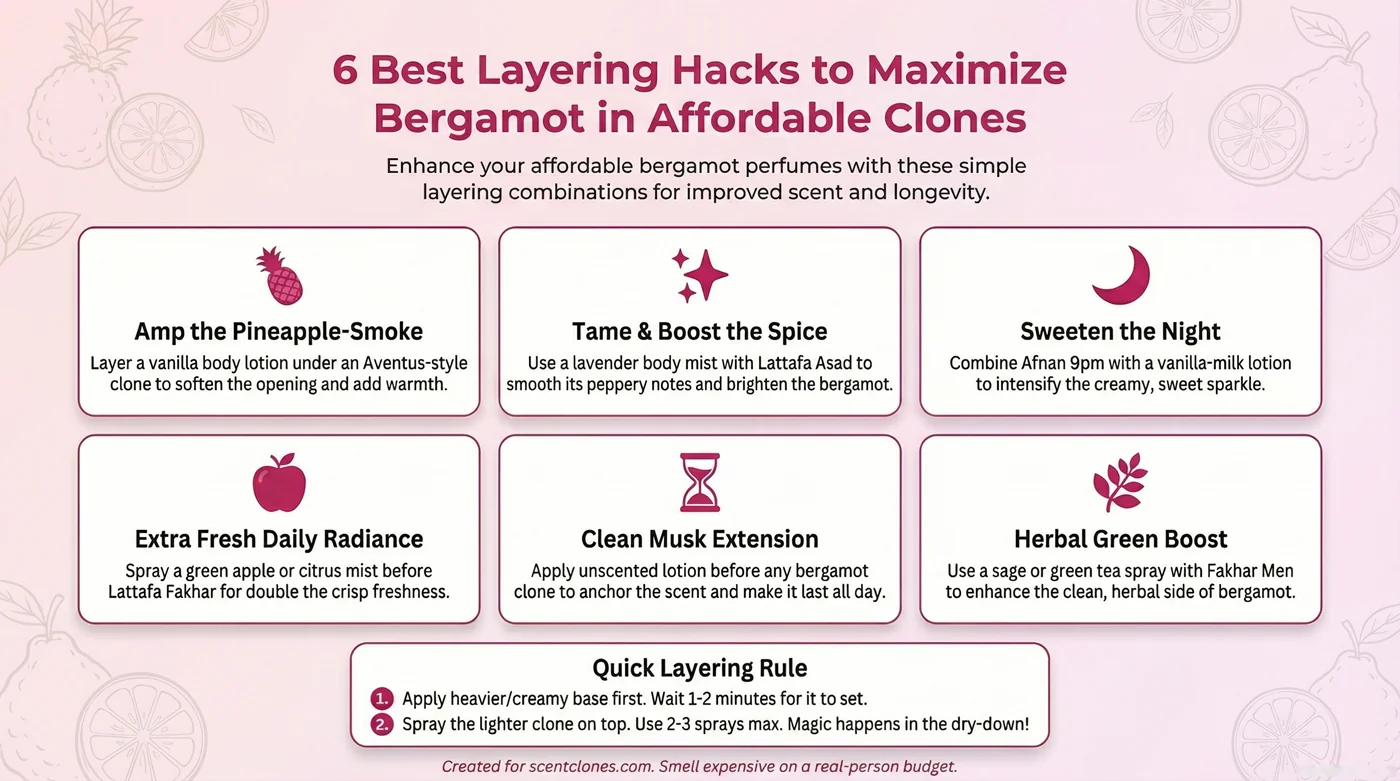
6 proven layering combos to make your budget bergamot clones smell even more luxurious and last longer. Save & try!
Want something drier or less intense? Keep scrolling…
What If You Want Even Less Sweet? Drier Alternatives
The six clones above all have some degree of sweetness—whether it’s pineapple in the Aventus DNA, vanilla in 9pm, or amber in Asad. That’s what makes them so crowd-pleasing and compliment-friendly. But I get it: sometimes you want a bergamot that’s drier, more aromatic, or straight-up classic cologne-style without any fruit or gourmand leanings. Here are four solid directions to explore if you’re craving something sharper and less sweet (all still budget-friendly).
Classic Cologne-Style (Neroli & Herbs)
Go for traditional Eau de Cologne clones with dominant bergamot, neroli, rosemary, and lavender.
Try: Armaf Tag Him, Rasasi Hawas (lighter batches), or Milton Lloyd Jeans Spirit.
Result: Pure, radiant bergamot freshness that feels timeless and ultra-clean. Zero sweetness—perfect for hot weather or when you want “expensive soap” vibes.
Woody-Aromatic (Green & Dry)
Look for bergamot paired with vetiver, cedar, or sage instead of fruit.
Try: Zara Vibrant Leather alternatives, Armaf Tres Nuit, or Lattafa Qaed Al Fursan.
Result: Dry, sophisticated bergamot with green-woody depth. Great for office or formal settings when you want elegance without any sweetness.
Clean Musk & Citrus (Minimalist)
Pure bergamot over white musk or ambroxan bases.
Try: Al Rehab Silver, Maison Alhambra Jorge Di Profondo clones, or Dossier Citrus Ginger.
Result: Transparent, skin-like bergamot that feels modern and understated. Zero sugar—ideal for close quarters or when you want subtle sophistication.
Straight Citrus Blast (No Base Sweetness)
Heavy bergamot with lemon, petitgrain, and herbal notes—no vanilla or amber.
Try: 4711 Original Eau de Cologne dupes, Avon Destination series, or Fine’ry Jungle Santal alternatives (citrus versions).
Result: Short-lived but incredibly refreshing bergamot explosion. Perfect summer splash or layering base.
My Advice
Keep one sweet/compliment-focused clone (like CDNIM or 9pm) for dates and evenings, and one drier option for work or hot days. Most days you’ll still reach for the main six above—the sweetness is what makes them so addictive—but it’s nice to have cleaner alternatives in rotation.
Ready to grab one? Here’s exactly where to buy right now…
Where to Buy These Bergamot Clones Right Now
All of these bergamot-heavy clones are currently in stock on Amazon with fast Prime shipping (as of today). Prices move around daily, so click through to lock in the best deal. I always recommend buying from official sellers or Amazon-fulfilled listings to avoid fakes or old batches. If you’re after an ultra-clean, modern bergamot bomb, don’t miss the newest Lattafa standout: Lattafa Breeze — a spot-on MFK 724 dupe with crisp bergamot and airy laundry musk (full brutal review linked).
Bonus Fresh Pick: Lattafa Breeze
≈ $25–$40 (100 ml) — ultra-clean bergamot + soapy musk (MFK 724 dupe)
Read Full ReviewPro Tip: These clones move fast—especially the top three and the fresh new Lattafa Breeze. Add your favorite to cart today while stock and pricing are good. For the full Breeze breakdown (including brutal 48-hour test vs real MFK 724), check this review.
Almost done—just my final thoughts and a quick FAQ coming up…
Final Thoughts + Which One I Reach For Most
After months of side-by-side testing, hundreds of sprays, and real-life wear in every possible situation, I can say this confidently: you do not need to drop hundreds on a designer bottle to get an incredible bergamot experience. These six affordable clones prove that bright, radiant citrus sparkle—paired with smoky woods, spicy warmth, or sweet vanilla—can feel legitimately luxurious for everyday money.
My personal ranking hasn’t budged: Armaf Club de Nuit Intense Man is still the one I reach for most. It nails that addictive bergamot-pineapple-smoke combo, projects like crazy, pulls the most compliments, and works year-round once you let it macerate. On days I want something spicier and beast-mode for cold weather, I grab Lattafa Asad. For nights out and maximum sweetness, Afnan 9pm. The lower ranks are situational winners—clean daily freshness from L’Aventure and Fakhar, raw power from Afnan Supremacy Silver —but every single one has earned permanent shelf space.
Best Overall & My Daily Reach
Armaf Club de Nuit Intense Man
Radiant bergamot-smoke, massive compliments
Best Longevity & Winter Beast
Lattafa Asad
Spicy bergamot intensity, nuclear performance
Best Night-Out Compliment Magnet
Afnan 9pm
Sweet bergamot-vanilla addiction
Best Clean & Versatile Daily
Al Haramain L’Aventure
Natural, office-safe bergamot radiance
Best Fresh Everyday Driver
Lattafa Fakhar Men
Crisp, modern bergamot-apple polish
Best Budget Powerhouse
Afnan Supremacy Silver
Bold, smoky bergamot on a dime
My honest advice?
Start with Armaf Club de Nuit Intense Man—it’s the safest blind buy and my personal favorite. Let it macerate, layer when you want to switch things up, and enjoy smelling expensive every day. You’ll wonder why you ever considered paying ten times more.
Got questions? The FAQ below covers the most common ones—or drop a comment, I read them all.